

Kith Garden Perennial Wildflower Seeds
$34.99$59.99
Order by Midnight for Guaranteed Discounts.
Get 50% OffWhat's Really In Your Seed Packet
Almost every packet on the garden-centre shelf holds a hybrid. It gives you one strong season — then the genetics scramble. Save those seeds, plant them next spring, and you get stunted plants, odd fruit, or nothing worth harvesting. So you buy again. Every year, forever.
There's a second cost. A study published in the Journal of the American College of Nutrition compared today's produce against mid-century records across 43 garden crops and found declines of up to 38% in some nutrients — pointing to decades of breeding for yield and shelf life instead of nourishment.
Once you know what's inside those packets, it's hard to keep buying them.


The Hidden Truth About Store-Bought Seeds
A study published in the Journal of the American College of Nutrition compared 43 garden crops against records from the 1950s. Several nutrients had dropped by as much as 38% — and the authors pointed at the varieties themselves, bred over decades for size, uniformity and shipping durability.
Plant a store-bought hybrid and you're growing a vegetable that looks like the one your grandparents grew, but doesn't quite deliver like it.
Here's how it happens:
Modern varieties are selected to grow fast, ripen evenly and survive shipping. Nutrient density was never the target — and it shows.
Save seed from a hybrid and next year's plants split in every direction — smaller fruit, uneven growth, traits you never planted. The parent genetics don't hold.
That's not an accident, it's the model. What used to be a one-time purchase quietly turned into a yearly subscription nobody asked you to sign.
Your great-grandparents saved seed as a matter of course. Your parents bought packets. Most gardeners today have never been told saving was even an option.
Dependency, Rising Costs & Generational Loss
Hybrid seeds don't just underperform in the bed — they build a standing dependency into how your household eats, and they cost far more over time than the packet price suggests.
Here's what that looks like:
A family garden runs roughly $40–$80 in seed every spring. Over ten years that's $400 to $800 spent on seed designed to be used once. Your great-grandparents paid once and were done.
If shelves thin out or prices jump, hybrid seed gives you exactly one growing season of protection. After the harvest you're back at square one with nothing to plant.
For thousands of years seed passed down alongside the knowledge of how to grow, save and replant it. That handover stopped in a single generation. Seed-saving is now a niche skill.
Plenty of "survival seed kits" are packed with hybrids, thin seed counts and varieties chosen to look good on the label rather than perform in a real bed. You're buying the feeling, not the function.


A Seed Vault Built For Families, Not Corporations
The fix isn't new and it isn't complicated. Families are going back to open-pollinated heirloom seed — the same varieties that fed households for generations, saved and replanted year after year without ever touching a shelf.
Why the vault is catching on:
Every variety in the vault is 100% open-pollinated. Save seed from your own harvest, plant it next spring, and you get the same vegetable back. One purchase becomes a permanent supply.
Not fifteen packets with a hundred seeds each. Sixteen thousand seeds chosen for how they actually perform in a home bed — tomatoes, peppers, lettuce, squash, roots and herbs.
Nothing engineered, nothing built to expire after one season, no yearly trip back to the store. These are the same genetics families relied on long before seed became a subscription.
Packed in airtight, moisture-resistant foil so the vault holds until the season you decide to open it — this spring, or five years from now.
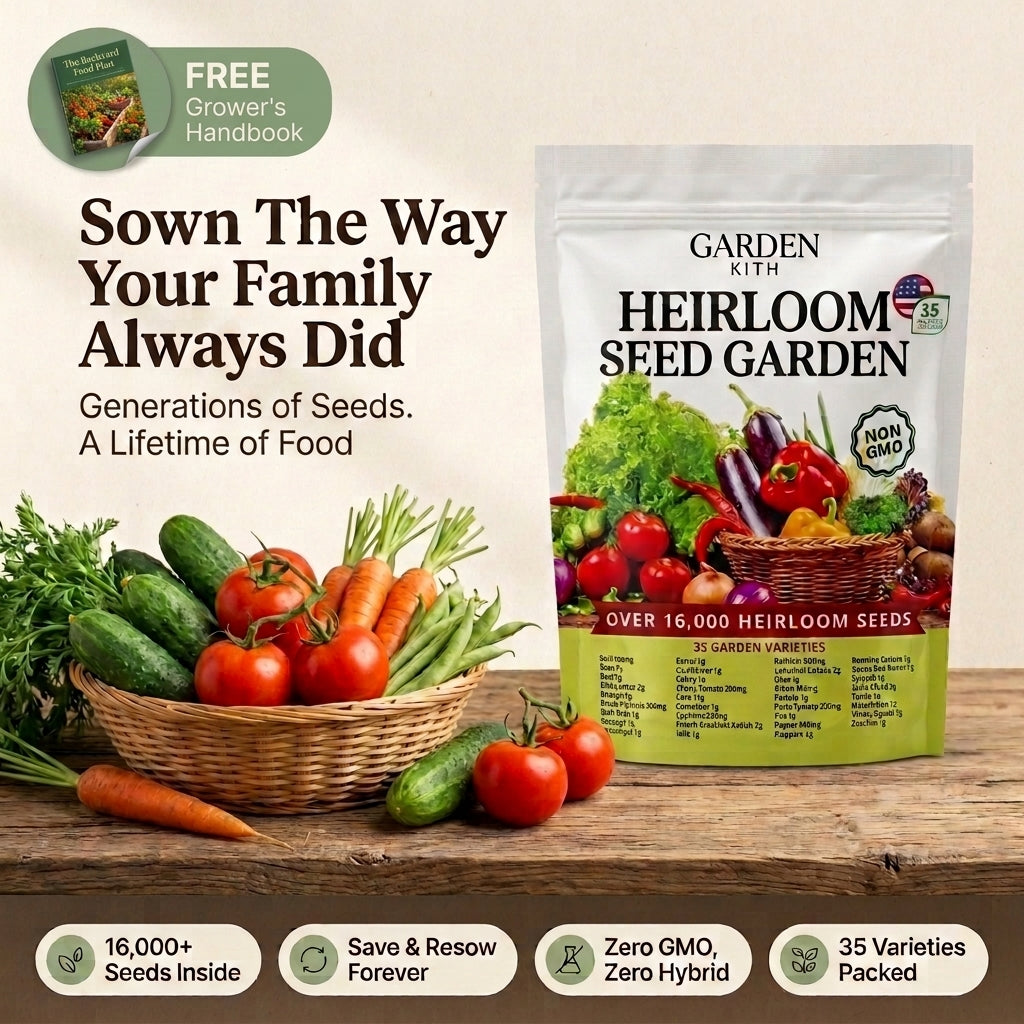
Say goodbye to hybrid seed. This is how seed should work:
⏱ Low stock — 17 kits left
Nearly every packet on a garden-centre rack holds an F1 hybrid — a controlled cross between two parent lines, bred to give one uniform, impressive harvest. That first season is genuinely good. The problem is the second one.
Save seed from a hybrid and the genetics separate out. The next generation doesn't come back true to type: you get uneven plants, smaller or oddly shaped fruit, weaker yields, sometimes nothing worth the bed space. That's not a defect — it's how the cross works. Which means every spring, you buy again.
There's a quality question underneath it too. Modern varieties were selected over decades for yield, uniformity and shipping durability. A study in the Journal of the American College of Nutrition compared 43 garden crops against records from the 1950s and found several nutrients had fallen by as much as 38%, with the authors pointing at those changing varieties as a driver.
And the varieties themselves have thinned out. A widely cited comparison of 1903 seed catalogues against 1983 seedbank holdings suggested the great majority of commercial food seed varieties had disappeared — sweet corn dropping from hundreds of listed types to a dozen, lettuce from several hundred to a few dozen. Researchers still debate the exact figures, but the direction is not in dispute: the shelf got narrower, and families ended up dependent on a handful of companies for something as basic as seed.
Every vault contains 16,000+ heirloom seeds across 35 hand-picked vegetable and herb varieties — tomatoes, peppers, lettuce, squash, roots, beans and kitchen herbs.
All of them are:
No filler packets, no ornamental oddities nobody cooks with.
Plenty of "survival seed kits" solve half the problem. They hand you a stack of packets with a few hundred seeds each, and quite often there are hybrids mixed in — which puts you right back inside the same system you were trying to leave. You plant them once, and next spring you're shopping again.
The other common issue is that these kits are assembled for shelf appeal. Obscure varieties nobody actually cooks with, seed counts too thin to feed a household, and no guidance on how to grow or save any of it.
The Kith Garden vault is built the other way round: 16,000+ seeds across 35 varieties, every one open-pollinated, chosen for everyday cooking and dependable germination. Save seed from your healthiest plants, replant next season, and you grow the same vegetable again. Year after year.
Far longer than the packets sold at a hardware store, which are typically packed in paper and start losing germination within a season or two on a shelf.
Our seed is sealed in airtight, moisture-resistant pouches built for long-term storage. Kept somewhere cool, dry and dark, most varieties in the vault hold strong germination for up to 10 years — tomatoes, peppers, squash, beans, brassicas and lettuce store especially well.
One honest caveat: a few seed types are naturally short-lived whatever you do. Onion, leek and parsnip lose vigour faster than the rest, so plant those within the first couple of seasons. The included guide flags which varieties to use early and which will happily wait.
Because everything in the vault is open-pollinated, that decade is really just the starting point. Once you begin saving your own seed, the supply renews itself.
Yes — that's the whole point of open-pollinated heirloom seed, and it's exactly what separates it from the hybrids sold everywhere else.
Save seed from your harvest and it produces the same variety next year. The genetics stay stable. This is how growing worked for thousands of years before seed became an annual purchase.
The process is straightforward: grow your vegetables, let a few of your best plants fully mature and go to seed, harvest and dry that seed, store it somewhere cool and dry, plant it next spring. Repeat indefinitely.
One thing worth knowing: some crops cross-pollinate with nearby relatives — squash and brassicas in particular — so if you're growing two varieties of the same species close together, keep a little distance or bag a few flowers. The included guide walks through it variety by variety. It takes about ten minutes to learn, and then you have the skill for life.
Absolutely. You don't need acreage to use this vault. Plenty of the 35 varieties do well in:
Lettuce, spinach, radishes, herbs and bush beans are particularly well suited to tight spaces. The growing guide marks which varieties handle containers best and gives pot-size and watering notes for each.
Suburban backyard, apartment balcony or a small patio — you can grow real food either way.
One vault covers you for years. The families who get the most out of it are the ones who set up the rest of the system at the same time.


