
5 Reasons 47,000+ Families Are Switching Back to Heirloom Seeds in 2026
Your grandparents never bought seed twice. Here's why the packets on today's shelves stopped working — and how one kit brings back food that grows itself, season after season.

By Laura P.
Last Updated Jul 17.2026


Your Grandparents' Seeds Grew Forever. Yours Don't.
For thousands of years, every household saved seed from its own harvest and put it back in the ground the following spring. Same tomatoes. Same peppers. Year after year. One purchase carried a family for generations.
Then the packets changed. Modern hybrids are bred to deliver a single strong season and nothing after it. Save that seed, plant it next spring, and the genetics come apart — uneven plants, misshapen fruit, sometimes nothing worth the bed space. That isn't a fault in the seed. That's the design.
The return trip to the shop every March is the business model, not a side effect. Heirloom seed behaves the way seed is supposed to: plant it, harvest it, save it, plant it again. Indefinitely.
A Handful of Companies Control Most of the World's Seed. You're Not Gardening — You're Subscribing.
In 1996, the first Roundup Ready crops came with something new attached: a technology agreement. Farmers who signed it gave up the right to save seed from their own harvest. For thousands of years, saving seed was simply what you did after a harvest. A contract ended that.
Consolidation did the rest. After a decade of mergers, four groups — Bayer, Corteva, ChemChina-Syngenta and BASF — came to dominate the global commercial seed trade. They don't sell you abundance. They sell you a return trip.
Meanwhile, on a frozen island above the Arctic Circle, a vault holds well over a million seed samples in cold storage, preserved against exactly the kind of loss this system creates. The old varieties are being protected. They're just not what's on the shelf.


Supermarket Seed Tastes Like Water. These Taste Like Something You Remember.
There are growers all over the world still planting tomato seed their fathers carried across an ocean decades ago. Ask them why they never switched and you get the same answer. One bite and the difference is obvious. It tastes like a July afternoon at your grandmother's house.
Almost everything bred in the last fifty years was optimised for the trip — shipping durability, uniform ripening, weeks on a shelf. Flavour was never the target. Which is why the tomatoes from your own garden can end up tasting suspiciously like the ones at the supermarket. Same corporate genetics, shorter journey.
Heirloom varieties were kept for the opposite reason. Someone tasted them, decided they were worth keeping, and passed the seed on. These are seeds people crossed oceans for.
Most "Emergency" Seed Vaults Are Filled With Seed That Won't Do the Job.
The usual pattern: someone buys an emergency seed kit, puts it on a shelf in the garage, and forgets about it. Assorted packets. Sealed pouch. No idea how to grow any of it. The day it actually matters is a bad day to be reading instructions for the first time.
Then there's what's inside. Plenty of kits on the market run thin — a few hundred seeds spread across a long variety list, hybrids quietly mixed in, and varieties picked because they photograph well rather than because they feed anyone. That's dependency sold as security.
The Kith Garden vault is built differently: 16,000+ seeds across 35 varieties, every one non-hybrid, non-GMO and open-pollinated. Which means one kit doesn't cover a season. Saved and replanted, it covers you indefinitely — and the included guides make sure you know how before you need to.


The Generation That Knew How to Feed Itself Is Nearly Gone. This Is How You Keep It.
If your grandfather is still around, he's in his eighties. His friends are thinning out. The last generation that could genuinely feed a household from a back garden is disappearing — and most of us never got round to asking them how they did it.
During the Second World War, American households planted victory gardens by the millions and grew a substantial share of the country's fresh vegetables in their own yards. They saved seed. They handed it down. Some of those tomato varieties are still grown today. One generation understood food security. The next one let it go.
Every Kith Garden vault ships with a beginner's guide and a season planner — the part nobody hands down any more. The seed, the method, and the order to do it in. Everything your grandparents assumed someone would eventually teach you.
Stop Buying Seed That Expires. Grow Food That Grows Itself.
The Kith Garden Seed Vault is available now at 50% off, with free shipping and a 90-day money-back guarantee. If the seed doesn't grow, send it back.
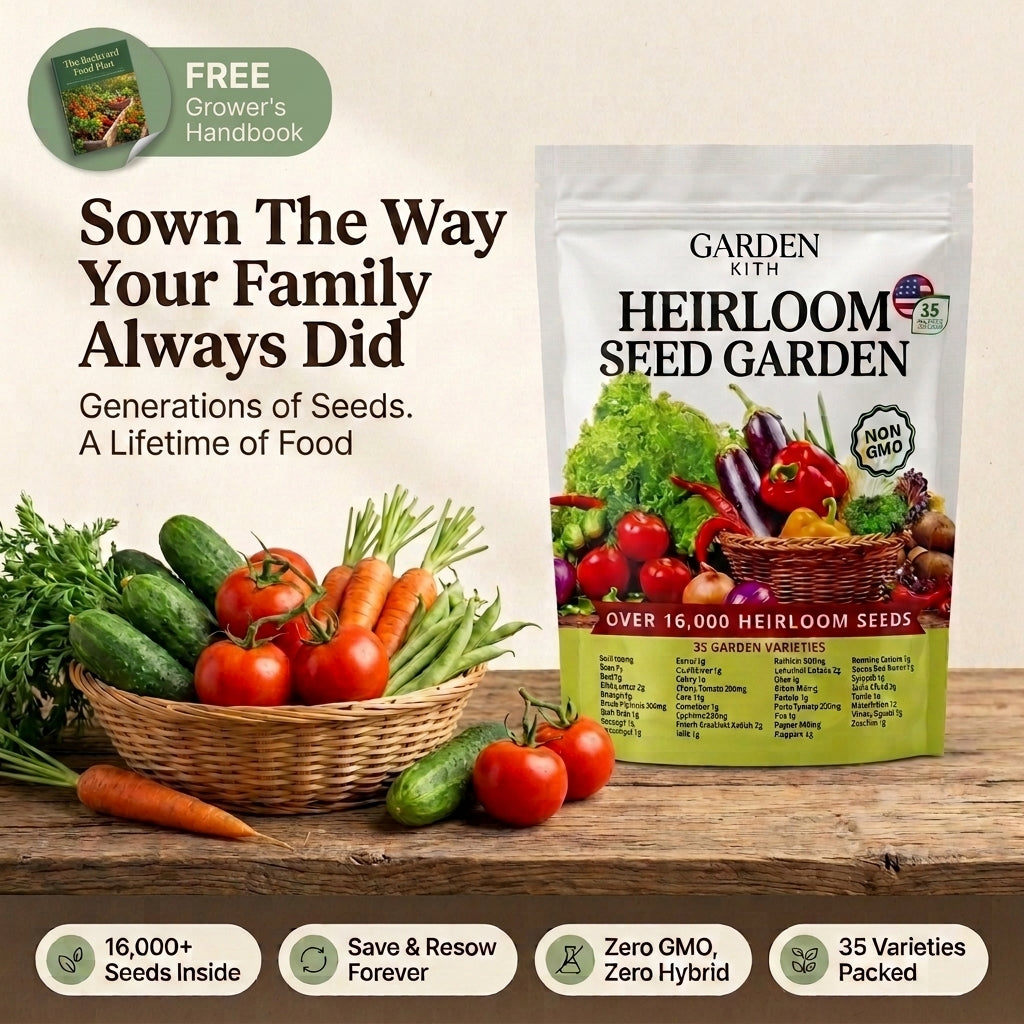
Kith Garden Heirloom Seed Vault Kit (35 Pack)
Say goodbye to hybrid seed. This is how seed should work:
- 🌱16,000+ heirloom seeds across 35 premium varieties
- 🔁100% open-pollinated — save and replant forever
- 🚫Non-GMO, non-hybrid — no engineered obsolescence
- 📦Airtight, moisture-resistant pouches for 10-year storage
- 🧑🌾Beginner-friendly — raised beds, containers or backyards
- 📖Beginner's guide and season planner included
⏱ Low stock — 17 kits left